Just south of Peterborough, along the Great North Road, lies a site that holds a unique place in military history. Norman Cross, the world's first purpose-built prisoner-of-war camp, held more than 5,000 French, Dutch, and German prisoners during the Napoleonic Wars; two centuries later, its story remains woven into the fabric of Peterborough and the surrounding villages.
The Construction of a Pioneering Prison
Work on Norman Cross began in December 1796, with 500 carpenters and labourers working for three months to construct a facility unlike anything previously built. The site was chosen for its strategic position: 76 miles north of London, far enough from the coast to deter escape attempts, with reliable water supplies and access to local food sources. The prison cost £34,581 11s 3d to complete and opened in 1797, operating until 1816.
The facility was designed based on contemporary artillery fortifications, featuring a ditch 27 feet wide and 5 feet deep surrounding the site. Initially protected by a wooden stockade, this was replaced with a brick wall in 1805 following escape attempts. The prison contained four quadrangles, each housing four double-storey wooden accommodation blocks holding 500 prisoners per block, alongside four ablution blocks. One block was reserved for officers, and the north-east quadrangle contained a prison hospital.
Life Behind the Stockade
At its peak on 10 April 1810, Norman Cross held 6,272 prisoners, though the average population was around 5,500. The majority were French soldiers and sailors, including midshipmen and junior officers, alongside Dutch prisoners and Germans conscripted into the French army. Approximately 100 senior officers and civilians of good social standing were granted parole d'honneur, allowing them to live outside the prison; many resided in Peterborough, with some as far afield as Northampton, Plymouth, Melrose, and Abergavenny. Four French officers and five Dutch officers married English women whilst on parole.
Conditions were challenging. Food rations initially included 1 lb of beef, bread, potatoes, and cabbage or peas daily, with herrings or cod substituted on Fridays for Catholic prisoners. From November 1797, a supply agreement with France ensured prisoners received 1 pint of beer, 8 oz of beef or fish, 26 oz of bread, 2 oz of cheese, and 1 lb of vegetables daily. The British government provided distinctive yellow suits, grey or yellow caps, red waistcoats, and yellow trousers to aid recognition of escapees.
Health problems plagued the prison. A typhus outbreak between 1800 and 1801 killed 1,020 prisoners. Other issues included pneumonia, consumption, and a night-blindness outbreak in 1806, which was treated with black hellebore. In total, 1,770 prisoners died during the prison's operation, though records remain incomplete.
Discipline was strict. The "Black Hole" was a windowless block where prisoners were kept shackled on half rations. Gambling was a persistent problem; some prisoners sold their clothes to fund gambling, and several died of starvation after losing their rations. In September 1808, following the stabbing of a civilian by a prisoner named Charles Francois Marie Bourchier, 700 daggers were discovered in the prison. Bourchier was hanged on 16 September 1808 in front of the prisoners, the only civil execution at Norman Cross.
The Craft Economy: Prisoners' Remarkable Legacy
Despite harsh conditions, Norman Cross became renowned for the extraordinary craftsmanship of its prisoners. Using materials including bone, wood, and straw, prisoners created toys, model ships, dominoes, and intricate marquetry. They were permitted to sell their artefacts twice weekly at local markets or daily at the prison gate, with prices regulated. Some highly skilled prisoners were commissioned by wealthy individuals and became remarkably wealthy themselves; prisoners carried home approximately £6,000 in profits when repatriated in 1814.
Archdeacon William Strong, on 23 October 1801, paid £1 15s 6d for a model of the Block House and £2 2s for a straw picture of Peterborough Cathedral. The prisoner's craft tradition extended to forbidden items; straw hats and bonnets were prohibited to protect local industry, as were obscene toys and drawings made from prison clothing.
The legacy of this craft survives today. Peterborough Museum houses over 800 Norman Cross artefacts, including bone and wood carvings, straw marquetry, model ships, and a doll's house. Thousands more pieces survive in museums and private collections worldwide. A model of the Block House made by a French prisoner in 1801 is displayed at the Musée de l'Armée in Paris.
Local Impact and Peterborough's Role
The prison's presence had significant effects on the surrounding area. Peterborough's volunteer forces were called upon to restrain prisoners during disturbances, with the Yeomanry galloping to support during a major defiance in 1804. Various militia units were stationed at the camp, including the Cambridgeshire Militia, North York Militia, Hertfordshire Militia, Bedfordshire Militia, and West Kent Militia.
In June 1816, the wooden buildings were dismantled and sold at auction. Some were relocated to nearby towns, with one building moved to Peterborough in April 1816 and converted into cottages, photographed in 1913. A few prisoners chose to remain in England, settling near Yaxley and Stilton.
What Remains Today
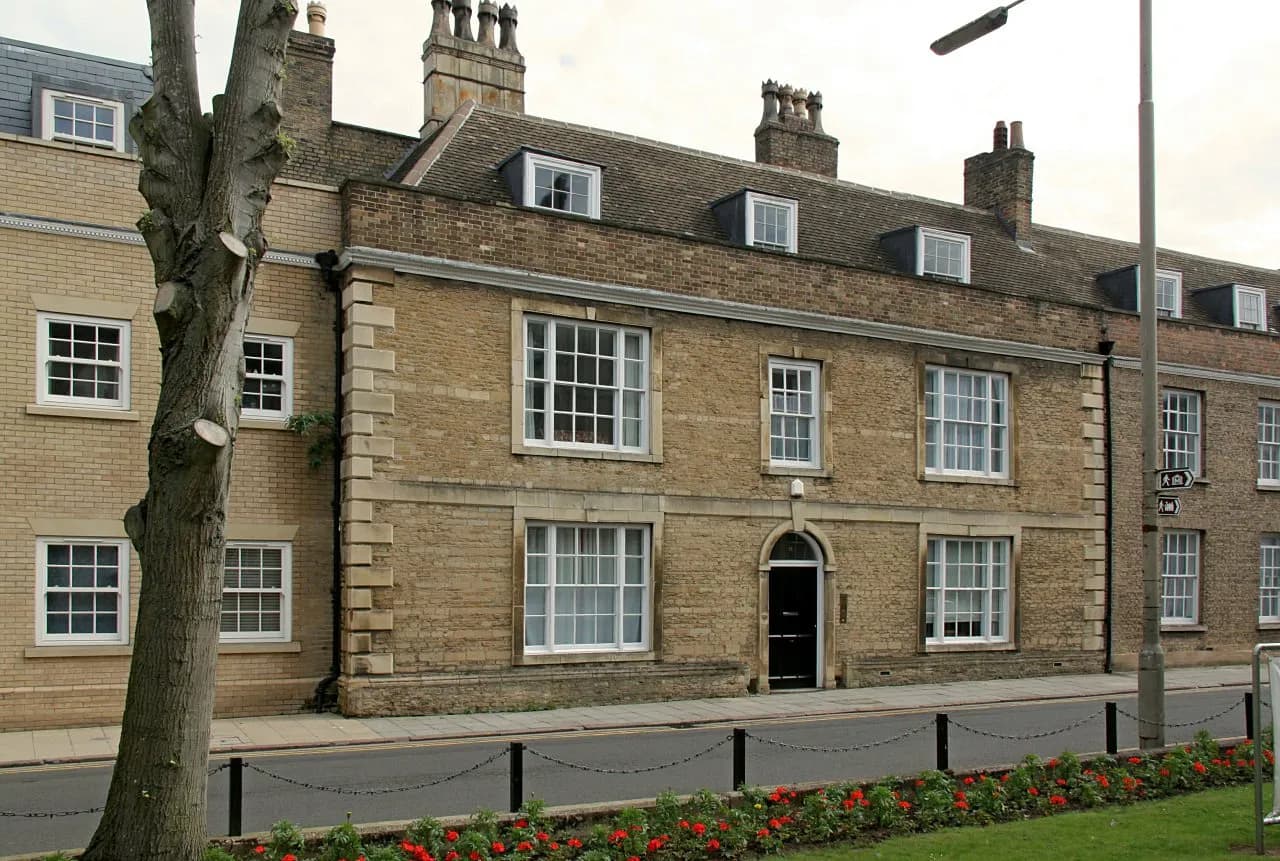
The site of Norman Cross is now a scheduled monument. Several structures survive: the Old Governor's House and Norman House are Grade II listed buildings, and the restored stables now serve as an art gallery. In 2025, the site was acquired by Nene Park Trust with grants from Historic England and the National Lottery Heritage Fund, and is now open to the public.
The Norman Cross memorial, erected in 1914 by the Entente Cordiale Society, stands beside the A15. The bronze Imperial Eagle atop the column was stolen in 1990 and replaced in 2005 after fundraising; the new eagle was sculpted by John Doubleday. The memorial was relocated in 1998 due to the A1 upgrade and was unveiled by the Duke of Wellington on 2 April 2005. It is also Grade II listed.
The prison's story gained renewed attention following a 2009 archaeological excavation by Channel 4's Time Team, which uncovered sections of the prison wall, an accommodation block, an ablution hut, and a burial ground. The episode, "Death and Dominoes: The First POW Camp," was broadcast in October 2010.
Visiting the Site and Museum
Peterborough Museum displays the largest collection of Norman Cross artefacts in the world. Located at Priestgate, Peterborough PE1 1LF, the museum is open Tuesday to Saturday from 10am to 4pm with free entry. The collection includes bone and wood carvings, straw marquetry, model ships, and a doll's house; all crafted by prisoners during the Napoleonic period.
The Norman Cross site itself, now managed by Nene Park Trust, is open to the public. Visitors can explore the location where the world's first purpose-built POW camp stood, see the memorial and surviving buildings, and reflect on the remarkable story of the prisoners who transformed incarceration into artistry; leaving an enduring mark on Peterborough and the world beyond.